

Low-voltage systems vary in type and function, yet they share a common principle: their electrical circuits are designed to transmit, receive and process information and to generate monitoring and control signals, rather than to deliver substantial electrical power to a consumer.
As a rule, such circuits operate at comparatively low voltages and currents. The specific electrical parameters depend on the purpose of the system, the interface used and the equipment deployed.
Unlike power systems, whose primary task is the transmission and distribution of electrical energy, low-voltage systems are intended first and foremost for carrying information, monitoring and control signals.
Low-voltage systems vary in type and function, yet they share a common principle: their electrical circuits are designed to transmit, receive and process information and to generate monitoring and control signals, rather than to deliver substantial electrical power to a consumer. As a rule, such circuits operate at comparatively low voltages and currents. The specific electrical parameters depend on the purpose of the system, the interface used and the equipment deployed.
Unlike power systems, whose primary task is the transmission and distribution of electrical energy, low-voltage systems are intended first and foremost for carrying information, monitoring and control signals.
The most common low-voltage systems include:
- structured cabling systems (SCS),
- CCTV security surveillance systems,
- access control and management systems (ACS),
- automatic fire alarm systems,
- early fire detection (aspirating smoke detection) systems,
- automated building management and monitoring systems (BMS).

«Behind the uninterrupted operation of a data center are hundreds of thousands of monitoring points and kilometers of cable lines that keep round-the-clock watch over temperature, humidity, power supply and fire safety. This entire “nervous system” of the facility is built on low-voltage systems. Let’s look at how they are designed, what functions they perform, and why the fulfillment of customer SLAs depends on them directly».
Andrey Rublev,
Head of the Low-Voltage Systems Group, Moscow South campus, IXcellerate
Functions of low-voltage systems in a data center
Low-voltage systems in a data center form the infrastructure that carries data from sensors to the monitoring system. They comprise a set of low-voltage equipment: cable lines, monitoring panels, controllers, I/O modules and network hardware. Two key functions are implemented on this technical foundation — an informational one and a control one.
The informational function involves collecting data from sensors that continuously record various indicators — temperature, humidity, pressure, dust levels and others — and transmit them to the monitoring system. These sensors include:
- gas analyzers (monitor the concentration of diesel fuel vapors in the air),
- temperature and humidity sensors (monitor the climate in the data halls),
- differential pressure sensors in air handling units (monitor the degree of filter clogging),
- data hall differential pressure sensors (monitor the maintenance of positive pressure so that dust does not accumulate on IT equipment),
- dust sensors (assess the amount of particulate matter in the air),
- carbon dioxide analyzers (measure the concentration of CO₂ in the air), and others.
The control function is performed by sending commands from the monitoring center to the engineering equipment. It is mainly used to adjust setpoints and operating parameters — for example, to change temperature thresholds, target pressure values, humidity and other process parameters.
Broader control capabilities are provided for air handling units. From the monitoring system, an operator can switch the units on and off, change their operating modes, adjust setpoints and control actuators such as air dampers and regulating valves.
For other engineering equipment that directly affects the operability and fault tolerance of the data center, remote control via the monitoring system is restricted or disabled. The system nevertheless continues to track the status of such equipment, display its operating parameters and alarm signals and, where provided for, allow individual setpoints to be changed.
This separation of functions rules out erroneous operator interference with mission-critical equipment and reduces the risk of an emergency caused by human error.
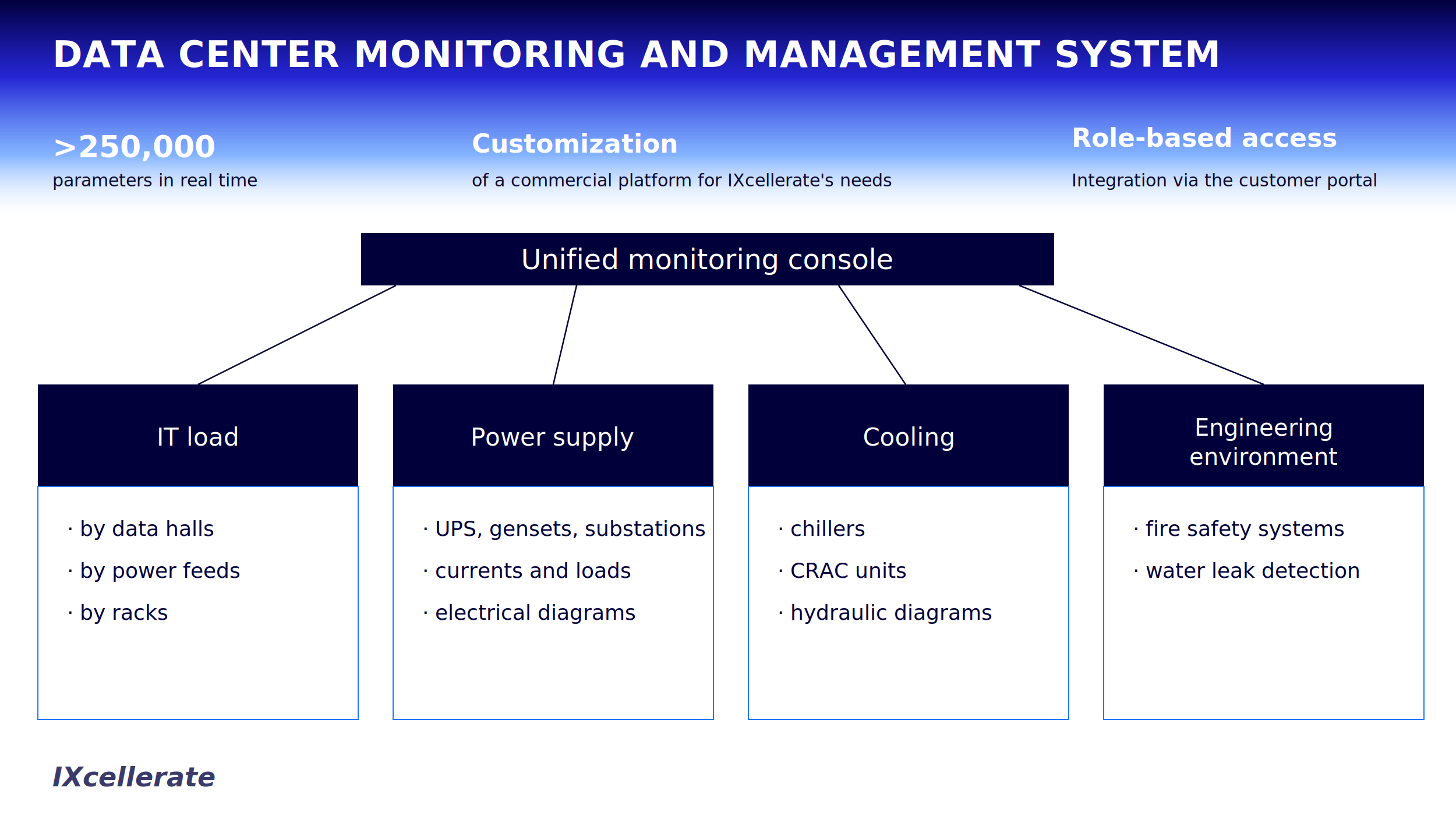
The total number of low-voltage elements depends on the scale and infrastructure of the data center. On average, a single data hall houses around 30 temperature and humidity sensors located in the cold aisles. In addition, dozens of supplementary sensors monitor the parameters of the cooling and ventilation systems, along with some 600–800 power monitoring and metering points, since all customer racks are fed via two power inputs and each input is monitored separately. In the MOS5 data center, located in the Moscow South campus, the low-voltage architecture comprises around 100,000 polling points, and across the entire IXcellerate ecosystem, which includes two data center campuses, their number reaches approximately 250,000.
Together, the informational and control elements of low-voltage systems ensure microclimate control and stable power supply to the data halls, as well as security and equipment management — all of which directly affects the operating efficiency of the data center and the fulfillment of SLA commitments to customers.
How it works
Low-voltage systems provide a two-way exchange of information between the monitoring system and the equipment. The monitoring panel of each data hall aggregates the readings of the air temperature and humidity sensors, the precision air conditioner sensors and the cooling equipment leak sensors, the parameters of the air handling unit serving that hall, and the statuses of the fire alarm systems.
Depending on the parameter being monitored, the collected signals are then routed to I/O modules with discrete or analog inputs, which ensure high-precision data acquisition. From the modules, the signals are passed to a controller that processes the data according to embedded algorithms. The information then travels through a switch over copper cabling to a telecommunications rack, from where it is transmitted over fiber to a server. From the server, the processed information is displayed on the monitors of the duty engineers, allowing them to track the status of the facility and decide whether intervention is needed.
The system automatically sends alerts whenever parameters go beyond the set limits (for example, when temperature or humidity is exceeded). Personnel intervene either in abnormal situations or when performing work that requires manual confirmation of commands.
Microclimate control
Climate requirements are set out in the SLA for each customer. The permissible temperature range in a data hall is 18 to 27 °C, with humidity between 30% and 70%. Low-voltage systems continuously collect data both directly from the equipment and from key airflow zones to prevent overheating and ensure that the SLA parameters are met.
In the data halls, sensor placement is organized with regard to the layout of the space and the airflow routes (hot and cold aisles). Each row of racks (18–20 units, depending on the model and hall capacity) is equipped with three temperature and humidity sensors that monitor the climate around the equipment installed in the racks.
Fire safety
Where strong airflows are present, conventional fire detectors designed to sense smoke or thermal radiation are of little use. Smoke driven by air currents may never reach the detector’s smoke chamber. And if it does, by that time the smoke concentration in the room has reached its limit, so that when the detector finally triggers, the spread of fire is already inevitable. That is why modern data centers use active aspirating fire detection systems.
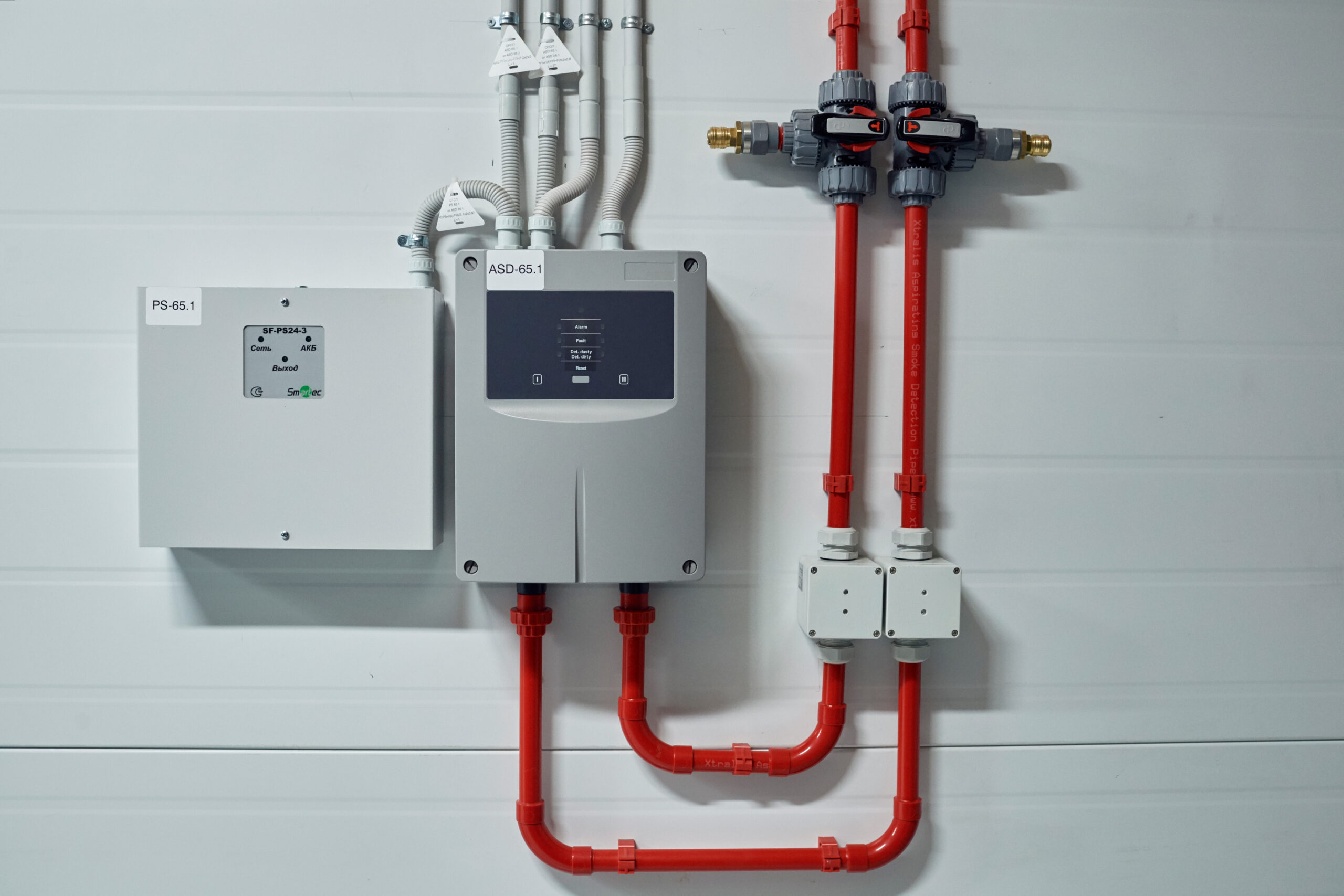
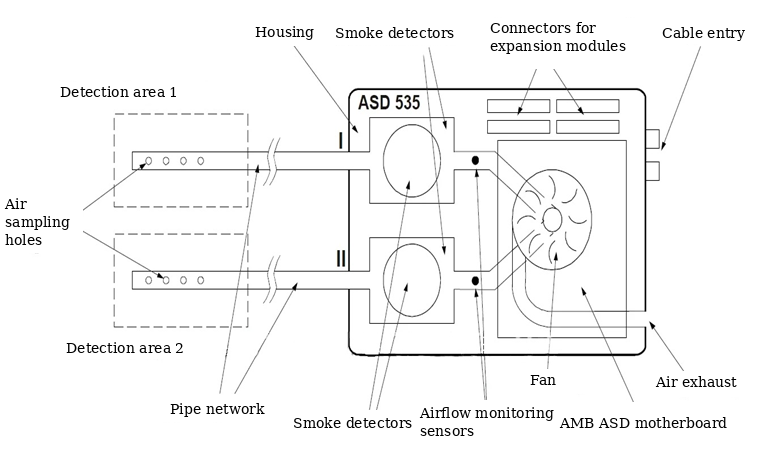
Aspirating systems are early fire detection systems. They typically have a modular architecture, which makes it possible to adapt the system to specific operating conditions and building layouts. The main components of such a system are a pipe network that draws air from the monitored area and the detector itself, which can be placed anywhere inside or outside the protected room.
The MOS5 data center uses an aspirating early detection system based on Securiton equipment: detectors of this class register smoke particles at the smoldering stage, long before open flames appear and traditional point detectors are triggered. Early detection makes it possible to contain an incident with routine measures, without activating the automatic fire suppression system or shutting down equipment — that is, without interrupting customer services. The use of systems of this class is taken into account by insurers when assessing facility risks and is a standard requirement in data center insurance.
Wired and wireless technologies
The engineering environment of the MOS5 data center employs both wired and wireless technologies; the choice is determined by reliability requirements and the specifics of the parameters being monitored.
Wired systems provide a stable, interference-free connection and are resistant to external influences, which is why they are used to connect the sensors monitoring most mission-critical indicators.
Wireless technologies are used selectively, mainly for rack power metering. A sensor (PowerTag) that records power consumption parameters is installed in each rack’s individual power tap-off box. Data from the sensor is collected via a proprietary wireless protocol in a network gateway (Power Link) and then relayed to the telecommunications rack over a wired (Ethernet) channel — this ensures transmission stability and reduces the risk of data loss.
The hybrid approach combines the reliability of backbone transmission with the flexibility of wireless data collection at the level of individual racks. Customers, in turn, get real-time access to the data through their personal account, and the system automatically generates notifications when power consumption limits are exceeded, making it possible to adjust the load in good time.
To sum up: wireless sensors are easy to install and reasonably priced, but they are less reliable than wired ones due to the risk of connection loss, as they are prone to failures caused by interference from the large number of Wi-Fi access points in a data center. For mission-critical parameters, therefore, wired sensors are the choice — they transmit data without interruption. Wireless sensors are used selectively, where short gaps in data collection will not affect the operation of the data center.
The monitoring system and the outlook for AI in data centers
Today, basic monitoring without AI is built on preset threshold values for each sensor (a minimum and a maximum). When readings go beyond these limits, the system automatically sounds an audible alarm and displays a text notification identifying the sensor and showing the current data. The duty operator analyzes the situation and decides how to proceed. This is the baseline level, on top of which predictive mechanisms already operate — for example, dynamic power balance calculation.
Could this scheme be optimized with AI — say, by taking the human out of the loop? In theory, yes, but at this stage it is not economically justified. The main reason is the high labor intensity of configuration: each scenario requires separate training of the system. Even a minimal change in the data (for example, a half-degree deviation in the value of just one of the multitude of monitoring points) creates a new case that has to be described. It is also critically important to set priorities in advance and clearly delineate which decisions are urgent and which are not. Taking all factors together, at this stage human oversight proves more effective and cheaper than automated solutions.
The outlook for AI lies in phased adoption — by analogy with the evolution of other technologies (from push-button phones to smartphones, from incandescent lamps to LEDs). Over the next three to five years, the most realistic avenues will be:
- extending predictive analytics to new response scenarios;
- analyzing equipment records (year of manufacture, maintenance schedule, etc.) to ensure timely maintenance and replacement;
- automating routine operations, such as generating work orders for engineers;
- optimizing scheduled maintenance by assessing the actual condition of equipment instead of following a rigid schedule, which can significantly cut costs. For example, analyzing diesel fuel quality would make it possible to replace it only when genuinely necessary rather than strictly according to the maintenance schedule, avoiding unnecessary expense.
For now this remains a prospect; today, in most situations — especially critical ones — the advantage stays with humans. In an emergency, an operator can act faster and more flexibly: for example, if a fuel supply pump fails on a running engine, they can quickly find a spare unit in the warehouse and manually arrange a temporary connection.
Non-standard solutions of this kind lie beyond the capabilities of even the most advanced software. Artificial intelligence in data center infrastructure is meant not to replace the specialist, but to become a tool that amplifies their expertise: the role of AI will grow not through full automation, but through the “smart” extension of the engineering team’s capabilities.