
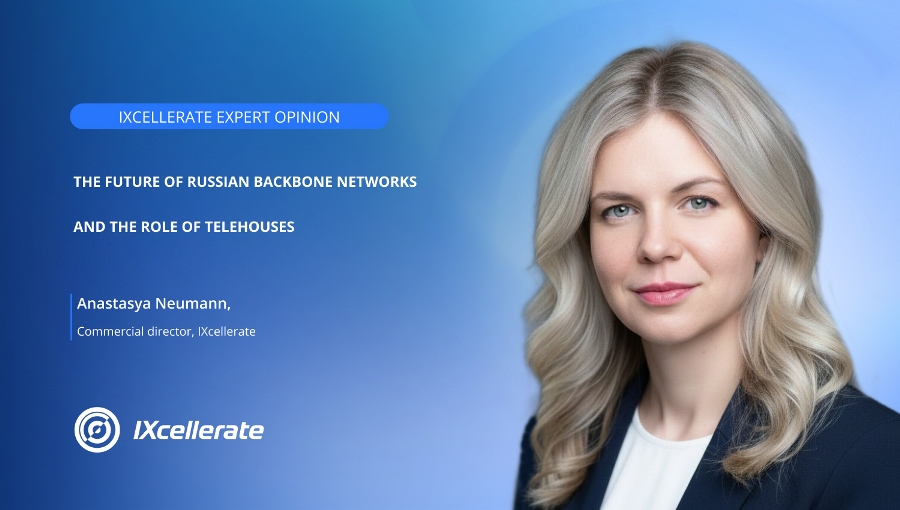
On March 24-25, 2026, the XVII International Conference “TransNet: Backbone communication networks,” organized by the ComNews group of companies, took place in Moscow.
Over 500 delegates gathered to discuss current issues in the development of telecommunications infrastructure in Russia and abroad.
IXcellerate participated in the conference and sponsored the section “Data Center Transformation and Telehouse Construction.”
Attendees paid particular attention to the presentation by Anastasya Neumann, Commercial Director of IXcellerate. Her report, “Data Center and Telehouse: happily together,” emphasized the importance of synergy between data centers and telehouses and its critical role in maintaining the connectivity and resilience of telecommunications infrastructure.
Data centers and telehouses: not competitors, but partners
Data centers provide computing power and data storage, while telehouses act as traffic exchange points, fostering network connectivity between telecom operators, content providers, and corporate data center clients. Only their interaction can ensure the necessary flexibility and stability of the entire Internet infrastructure.

«Data centers and telehouses are not competing, but rather complementary components of the infrastructure».
Anastasya Neumann, Commercial Director of IXcellerate
Constraints and energy limits in Moscow
Conference participants also focused on the power deficit in the Moscow region and limitations at MMTS-9 – the largest Russian telecom hub.
On the one hand, risks of super-concentration of carriers in one location and the need for geo-redundancy of network infrastructure are regularly discussed within the professional community; however, no concrete measures at the industry level have yet been taken to minimize these risks. On the other hand, growing regulatory requirements and the introduction of new capacities for traffic filtering complicate the development of existing platforms due to insufficient power supply and scaling limitations. One possible solution to this problem and a necessary task for industry development is the migration of carriers to new telehouses, which can relieve the burden on central hub and provide more flexible connection conditions.
Carriers’ evolution in Telehouses
The conference also discussed the evolving role of communication providers in telehouses, from organizing nodes to creating a full-fledged network core with ports up to 1 Tbit/s. Such a transition requires significant financial and technical investment. Experts note that if root routers of several carriers are housed in a data center, the site effectively becomes a telehouse. This requires:
- Providing conditions for colocation and uninterrupted operation of hadware installed with network nodes according to regulatory requirements.
- Ensuring the readiness of all ecosystem participants to invest – this will open access to alternative telehouses for a wide range of content generators and CDN providers.
IXcellerate, a key player in the data center market, was cited as a successful example of such a transformation, providing modern, highly scalable facilities for equipment placement. The provider is also distinguished by its transparent pricing policy, network neutrality, and a wide range of connectivity services.
As Anastasya Neumann highlighted in her speech, the presence of telecom operators in new telehouses depends not only on technical characteristics and economic feasibility. A significant motivator is the potential risks of incidents at an over-concentrated hub, network degradation, and, consequently, loss of profit and reputation. These risks can be minimized through a more flexible and independent infrastructure.
Conclusion: from centralization to distribution
Participants of the TransNet 2026 conference unanimously agreed: the future of Russian backbone networks and internet infrastructure depends on the possibilities of geo-distribution and decentralization of traffic exchange. The creation of new, independent telehouses will help reduce network failure risks, provide opportunities for further scaling, and accommodate additional equipment.
As IXcellerate’s experience has shown, traffic distribution through new telehouses allows for the creation of more flexible and fault-tolerant connectivity. Today, the company already hosts over 50 communication operators in its telehouse and provides connectivity to leading peering platforms (MSK-IX, Eurasia Peering IX, and Data-IX) via high-speed ports up to 400 Gbit/s. IXcellerate’s new campus in Vёshki, with a capacity of 130 MW, and the scaling of the Moscow South campus demonstrate that the evolution towards a distributed and fault-tolerant ecosystem is not a distant prospect, but a realistic and effectively functioning project.