
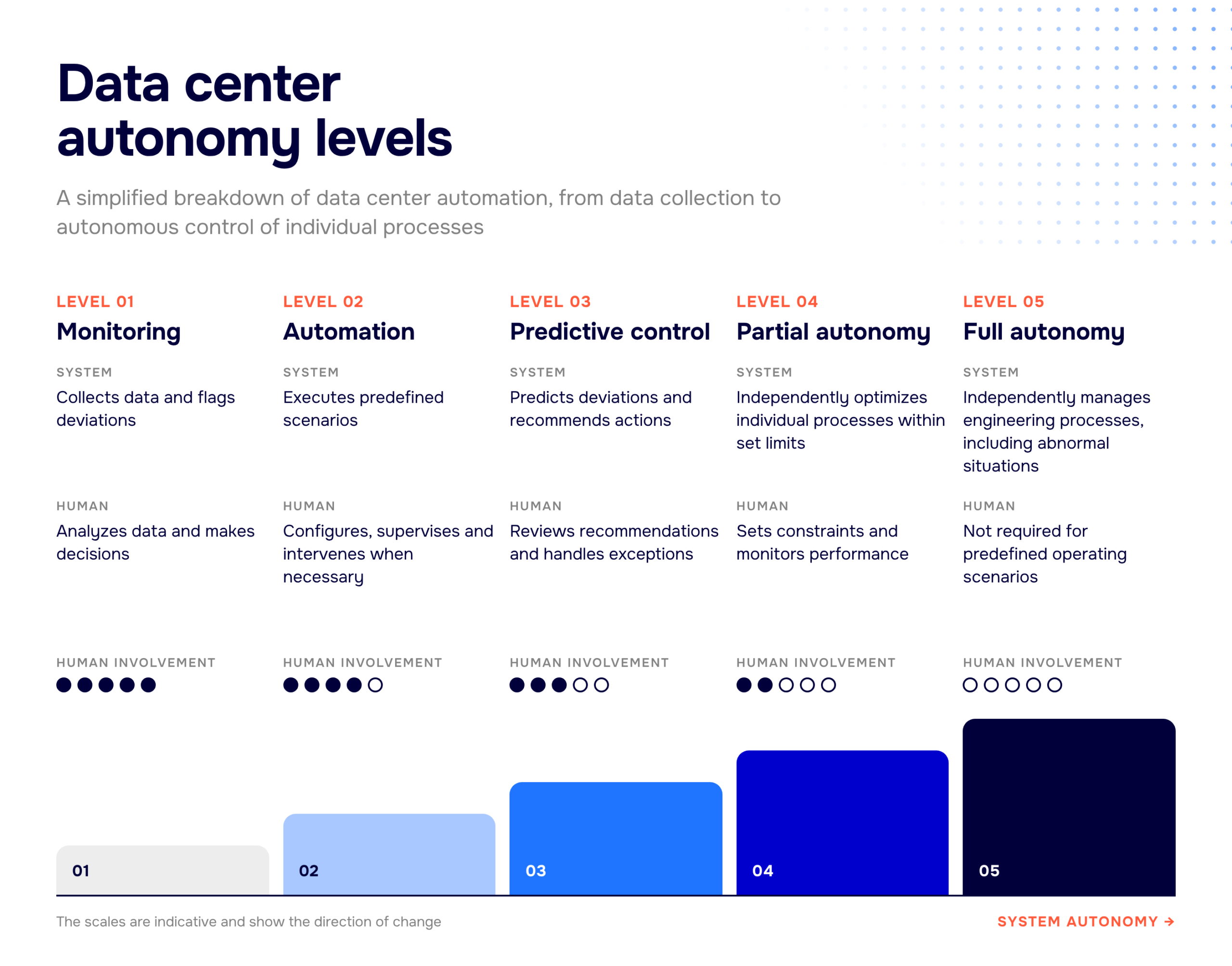
AI-driven automation is spreading to more and more areas, and the data center industry is no exception. New intelligent technologies are moving data centers towards autonomy and self-management. This trend resembles the path of self-driving cars. At the entry level, the car only warns of danger; at the next level, it helps with steering and braking while the driver remains in control; ideally, it takes over driving completely.
In theory this is possible, but in practice the final say and the final action still belong to the driver. The same is happening in a data center: smart systems are taking on more and more functions, but key decisions are made by the engineers of the technical service team.
Can we imagine a data center where no engineer shows up for weeks? Yes, such data halls already exist. But a fully autonomous commercial data center that can handle any emergency on its own and restore equipment without human involvement remains more of a concept than a reality.
What prevents us from handing human functions over to machines?
Lights-out data center: the background
Facilities where automation makes it possible to operate without permanent on-site staff are called lights-out data centers. The term came to the IT industry from manufacturing and the concept of lights-out manufacturing. Its literary prototype is the short story Autofac by the well-known science fiction writer Philip K. Dick, who back in 1955 imagined factories that run on their own, without personnel[1] .
The idea has been tested more than once. For example, back in 2011 the American internet provider AOL launched ATC, an unmanned modular facility. Failures were resolved during scheduled maintenance, workloads were shifted to other sites, and failed equipment was repaired on schedule by contractors or vendors. The project showed that a data center can operate without permanent on-site staff, but it was not developed significantly beyond the pilot model.
Microsoft went even further. As part of Project Natick, the company placed a sealed container with servers on the seabed off the coast of Scotland and monitored its operation for two years. The facility ran without a permanent human presence and used the surrounding water for cooling. The experiment showed that a sealed underwater module can operate stably over a long period, but it did not prove that fully autonomous data center operation is possible. For repairs and maintenance, the equipment had to be lifted to the surface.
Both examples show that the lights-out data center is no longer science fiction, but the path from an unmanned facility to a fully autonomous data center is much more complex than it seems.
What do machines already do?
A data center’s engineering infrastructure is controlled by several interconnected systems. DCIM (Data Center Infrastructure Management) collects and visualizes data on the facility’s status, helps track resource utilization and detect deviations. Individual engineering processes, such as cooling regulation or power switching, are managed by dedicated automation systems and controllers. Depending on the data center architecture, these systems can exchange data and operate within a single control loop.
At set intervals, the monitoring system receives data from numerous sensors that ensure the uninterrupted operation of data halls and track various parameters: temperature, humidity, power consumption, and the status of backup generators, cooling systems, fire alarm and fire suppression systems, etc. The IXcellerate ecosystem, which includes three campuses, uses about 380,000 monitoring points. Continuous monitoring makes it possible to keep equipment in its optimal operating mode and respond promptly to faults.
Interconnected monitoring and automation systems can record violations and also launch predefined response scenarios. For example, cooling controllers adjust equipment operation depending on temperature and load, and power supply systems automatically switch to a backup source under certain conditions. In the event of a failure, automation responds within seconds, much faster than a human. Yet even with this speed and precision, its capabilities are limited.
What can’t be entrusted to algorithms?
The main limitation of automation is that a program can only act within the scenarios it knows, and sometimes reality does not fit the predefined logic. A situation may arise that cannot be foreseen in advance.
A non-standard emergency requires non-standard solutions. A fire alarm system can detect signs of fire and launch the scenario provided by the procedure: alerts, control of engineering systems and other actions. But if the actual situation differs from the design one, for example, if the system receives conflicting smoke signals, specialists need to assess the situation using data from several systems, verify the readings and determine further actions in accordance with the emergency operating procedure. If an equipment fault is detected, an engineer may need to intervene physically. Such actions cannot be reduced to a single universal rule.
AI and predictive analytics
Automation makes it possible to respond quickly to deviations and keep systems operating within set limits. The next level of maturity is the shift from reaction to prediction. Uptime Institute notes[2] that the most advanced AI use cases in data centers are related to data analysis: the algorithm detects deviations, analyzes parameter trends and alerts the engineer, making it possible to fix a problem before it turns into an emergency.
Google’s data center cooling management project demonstrated the practical benefits of AI. By analyzing data and predicting temperature increases, the system helped reduce cooling energy costs by 40%. Later, control was automated: the AI suggested commands on its own, automation checked them for safety, and operators retained the ability to intervene and change the operating mode[3].
However, this example does not mean that such models are ready for mass adoption. The size of investment in AI technologies is not the only barrier. Training neural networks requires an extensive dataset, including data on abnormal situations. This creates a paradox: the more reliable a data center is, the less often failures occur, and the fewer real cases there are to train the recognition and prediction of abnormal situations.
Predictive analytics opens up great opportunities for data center management, but its potential is still largely untapped. AI does not erase the line between intelligent automation and full data center autonomy, because even a highly accurate forecast does not guarantee that the system will respond correctly to every abnormal situation. Predicting a failure is not the same as preventing or fixing it. To do this, AI must be connected to control systems, and engineers must retain the ability to monitor their operation and intervene when necessary.
Energy resilience: the Iceland experience
Data center autonomy can be significantly increased today. A clear example is a data center campus in Iceland. It is powered by renewable energy sources (RES), namely hydro and geothermal power plants, and the cool climate allows servers to be cooled with outdoor air without constant operation of chillers. At the same time, autonomy does not mean giving up redundancy: in 2022, the operator announced a trial of hydrogen fuel cells for the campus’s backup power. The aim of the experiment is to test whether hydrogen produced with renewable energy can be used as a greener alternative to traditional backup sources.
Renewable energy, free cooling and well-designed redundancy reduce operational risks and can significantly cut the volume of manual operations, but the facility still needs staff to fix faults.
All these examples show that a data center can operate without a permanent on-site staff presence, but cannot do entirely without people. A 100% autonomous facility remains more of an engineering goal than an established industry practice.
Despite the rapid development of AI, operators do not seek to remove people from the control loop completely. Rather, they aim to reduce staff involvement to a reasonable minimum and engage people where they are truly needed.
The most realistic model today is a smart division of functions rather than a rejection of people. Machines collect data, predict deviations and perform routine operations. Engineers monitor system operation, maintain equipment and make decisions in non-standard situations. Whether a permanent on-site shift is required, or remote control with field maintenance is enough, depends on the facility’s architecture, client requirements and risk assessment. Combining automation with human expertise helps the operator meet client SLAs and improve data center reliability.
FAQ
Without permanent on-site staff, yes, such models exist. Data centers that need no people at all, including for maintenance, repairs and emergency response: no, there are no confirmed examples of such facilities in full-scale commercial operation.
A data center where automation makes it possible to operate the infrastructure without a permanent human presence in the data halls.
To fix emergencies, maintain equipment and respond to abnormal situations that are not covered by predefined scenarios.
Power generation from hydro and geothermal plants makes a facility less dependent on external infrastructure: a stable power supply reduces the number of emergencies and the need for constant monitoring.