The rapid development of artificial intelligence is reshaping data center requirements. Power density is increasing, cooling architectures are becoming more complex, and the role of engineering infrastructure and highly skilled teams is more important than ever.
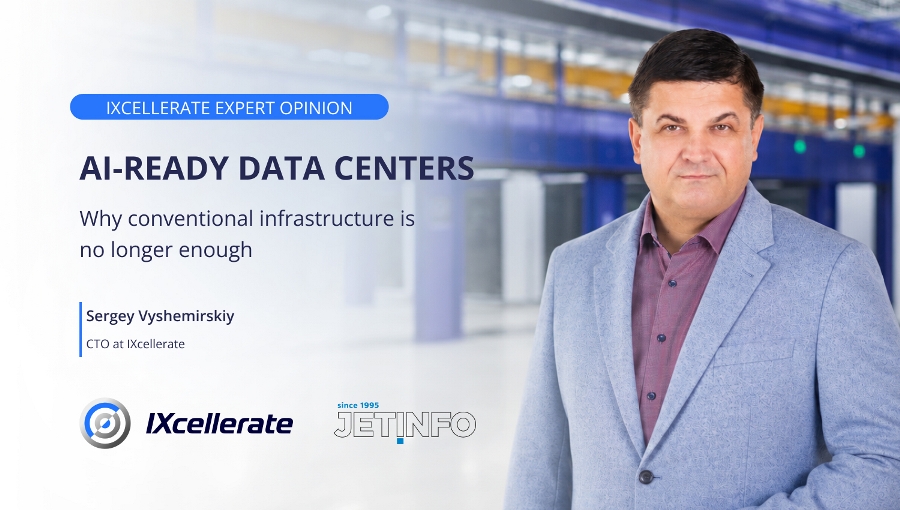
In an article for the industry publication JetInfo, Sergey Vyshemirskiy, CTO at IXcellerate, explained why a classic data center can’t simply be “retrofitted” for AI and machine learning workloads.
According to Sergey, these workloads fundamentally change the logic of the data center design. While a standard rack typically consumes 5–10 kW, machine learning workloads can drive this figure up to 40–60 kW.
Across IXcellerate customer base, the average rack load has already reached 12 kW, with some contracts exceeding 20 kW. At densities starting from 50 kW per rack, traditional air-cooling systems either become technically insufficient or economically unviable.
At IXcellerate South Campus in Moscow, a dedicated laboratory has been designed to test colocation solutions for supercomputing systems with power capacity of up to 200 kW, using a hybrid water- and air-cooling system.
The key principle highlighted by Sergey is the need to build architectural and power headroom into the design at the concept stage. Converting an existing facility to accommodate high-density AI workloads is virtually impossible without replacing core engineering systems or essentially rebuilding the operational model. At the same time, AI compute workloads can tolerate short planned interruptions without data loss, which makes it possible to reduce excessive redundancy and optimize capital expenditure.
Another major challenge for the Russian market is the availability of solutions and components. In response to these constraints, IXcellerate is developing its own R&D center. The company’s in-house engineering team has designed a high-load data hall cooling unit and system — a static pressure air cooling chamber. The solution has passed an independent expert review by Rospatent and is already in operation, supporting a total load of more than 30 MW.
Talent is another critical factor. Over the past year, IXcellerate’s headcount has grown by approximately one third. Finding an experienced, highly qualified specialist typically takes two to three months. IXcellerate has been collaborating with the National Research University “MPEI” and other specialized universities for several years: company experts contribute to curriculum development, deliver guest lectures, and students complete internships with the opportunity for future employment.
Read the full article here (in Russian).